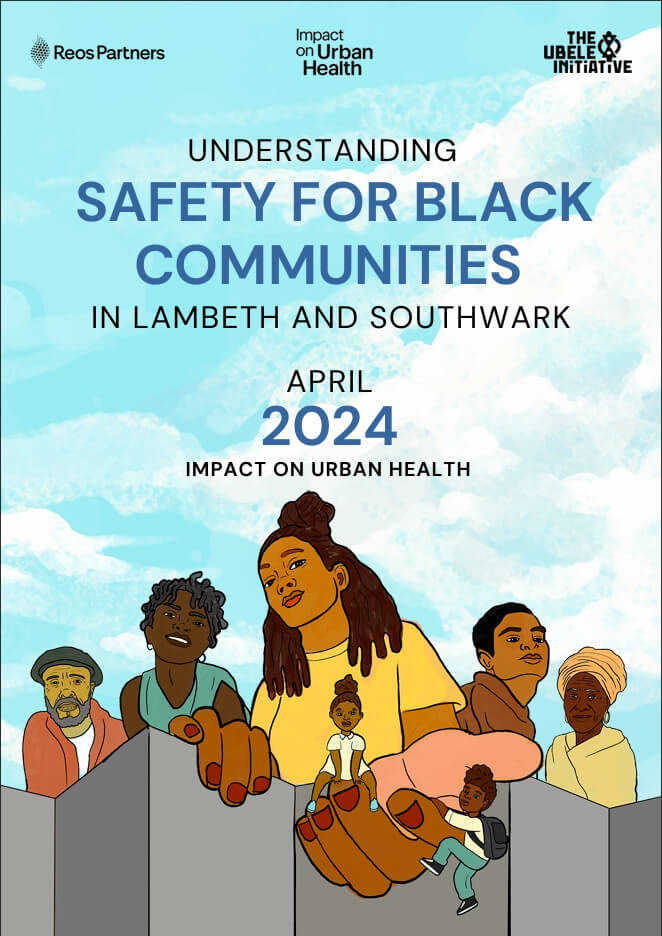

How do funders understand issues of safety for Black and racially minoritised communities? And how do these understandings of safety shape and influence the allocation of resources to communities most impacted by a lack of safety?
The Black Systemic Safety Fund was an 18-month process designed and facilitated by The Ubele Initiative and Reos Partners using a social lab approach. Core to the process was a desire to put power into the hands of Black and racially minoritised communities to define for themselves how safety might be understood and interpreted within their own localities.
Furthermore, it was a process designed to understand how more community-driven interpretations of safety might shape and influence the allocation of resources to address local safety challenges using a participatory grantmaking (PGM) approach that shifted decision-making beyond understandings of safety influenced by funders and other public systems.
In this report we uncover learnings and insights from the Black Systemic Safety Fund, outlining how and why safety was selected as an area of focus for communities in Lambeth and Southwark. We highlight how local experts and community leaders came understand safety as a big, broad and complex concept – one that has to be engaged beyond the narrow lens of crime and justice to truly ensure the thriving of Black and racially minoritised communities.
We then explore how an expanded understanding of safety allowed for the development of a range prototypes addressing safety within 1) the philanthropic sector, 2) the education sector, and eventually, 3) as a component of crime, justice and policing.
Finally, we conclude by sharing a key insight for future work in this area: that explorations of safety within Black and racially minoritised communities must be facilitated by Black facilitators and implementing partners if we are to create the safe containers required to generate new ways of looking at stuck challenges, and ultimately to seek out new ways of allocating resources that might allow us to more effectively address safety challenges.